Climate study warns of vanishing safety window—here’s why

From National Geographic:

A NEW SCIENTIFIC analysis of millions of possible climate futures found only a narrow window to keeping global warming to levels the international community has deemed safe.

Out of 5.2 million possible climate futures, carbon emissions must reach zero by 2030 in every country in the world if we are to stay at less than 3.6 degrees Fahrenheit (2 degrees Celsius) by 2100 of warming, the target set by the United Nations to avoid the worst impacts of climate change, from rising seas to deadly heat waves.


Read more here

The Rapid Decline Of The Natural World Is A Crisis Even Bigger Than Climate Change

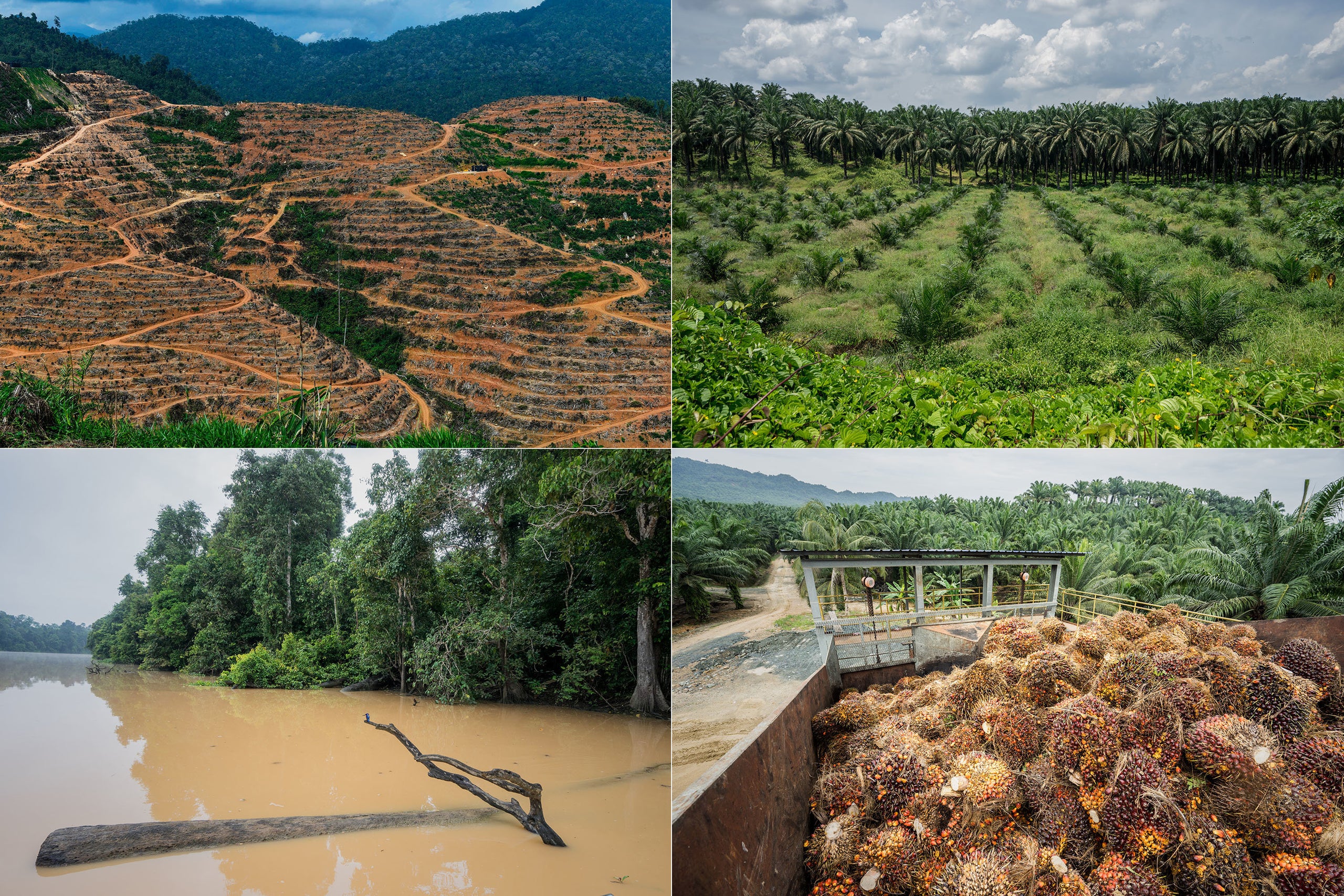
Left top: A durian plantation in Raub, on the outskirts of Kuala Lumpur. Soaring demand for durians in China is being blamed

From Huffington Post:

A three-year UN-backed study from the Intergovernmental Science-Policy Platform On Biodiversity and Ecosystem Services has grim implications for the future of humanity.

Nature is in freefall and the planet’s support systems are so stretched that we face widespread species extinctions and mass human migration unless urgent action is taken. That’s the warning hundreds of scientists are preparing to give, and it’s stark.

The study from the Intergovernmental Science-Policy Platform On Biodiversity and Ecosystem Services (IPBES), expected to run to over 8,000 pages, is being compiled by more than 500 experts in 50 countries. It is the greatest attempt yet to assess the state of life on Earth and will show how tens of thousands of species are at high risk of extinction, how countries are using nature at a rate that far exceeds its ability to renew itself, and how nature’s ability to contribute food and fresh water to a growing human population is being compromised in every region on earth.

Read more here

The Arctic Could Still Warm Over 15 Degrees This Century Even If We Meet the Paris Agreement Pledges

From Earther:

A new report from the United Nations shows that it’s basically game over for the Arctic as we know it.

Even if carbon pollution magically stopped tomorrow, the region’s winters would still warm an astonishing 5 degrees Celsius (9 degrees Fahrenheit) by century’s end, according to the UN. Meeting the Paris Agreement pledges—which do not get us to the two degree warming goal—would lead to that level of warming by midcentury and up to 9 degrees Celsius (16.2 degrees Fahrenheit) by 2100, along the way unraveling one of the most fragile ecosystems on the planet and displacing people who have done very little to cause the disruption.

Read more here

Will peak oil save us from the worst of climate change?

By Steve Austin

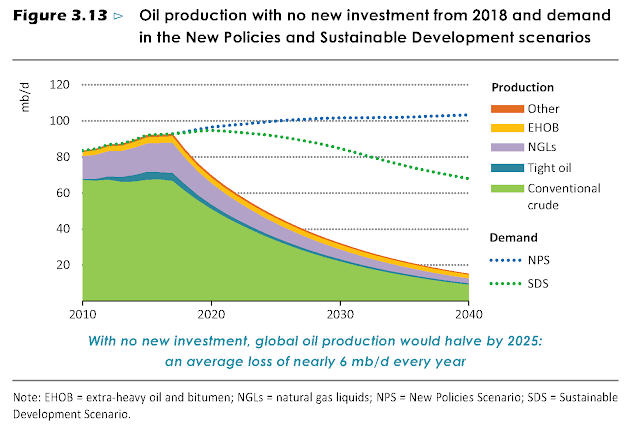
The IEA 2018 World Energy Outlook (executive summary here) suggests that peak oil – the time when oil returns begin an inexorable decline – is here and that a significant supply crunch could occur within the next 4 years. Alice Freidemann – the Energyskeptic – has reviewed the latest report which shows “a civilization crashing 8% decline rate that the IEA hopes will be brought to an also civilization crashing 4% rate with new oil drilling projects.”

This is very scary news. Our current growth oriented industrial economies cannot function with a dwindling supply of oil.  But that is precisely what is needed to mitigate the worst effects of the climate crisis. It is perhaps naive to expect that we will voluntarily end the industrial era by limiting our use of fossil fuels.  But it may be that nature will do that for us.

On page 159 of the IEA 2018 World Energy Outlook the following graph can be found:

What this shows is a gigantic gap between what we want – demand – and what will be available within 20 years.  In order to fill that gap, new discoveries would need to come on-line within that time frame. Those discoveries would have had to happen by now in order to enable the infrastructure to be in place to exploit them within the next 20 years.  Yet there have been no significant discoveries that would fill this gap, nor are any forecast.  (see chart below)

The gap between supply and demand will likely cause massive economic disruption, perhaps even sending the interlinked global economy into a ravaging depression.   Such a thing will be extraordinarily destructive, for we have no plans in place to deal with the end of the fossil fuel era – either voluntarily or forced.

While I do not welcome the pain and disruption we are facing, the silver lining may be that this forced end to the industrial era could also end the annual increase of carbon dioxide in the atmosphere.  This would be very welcome – nature’s way of keeping us from letting CO2 in the atmosphere get too far out of hand.   This would leave us at a manageable point to begin drawdown.  Ultimately, it would ensure that we would have a chance of building the next economy – an economy not predicated on ecocide and injustice – within a livable climate.  A livable climate in which to do this is not assured AT ALL under the current trends.

“Business-as-usual” economics will lead us to “Hothouse Earth”

From Economic Growth and Carbon Emissions: The Road to ‘Hothouse Earth’ is Paved with Good Intentions

Enno Schröder and Servaas Storm∗ + Working Paper No. 84 November 2018

It is high time that we do whatever it takes to stop the self-destruction of capitalism, not just in the interest of society and nature, but in the economic interest as well: “a self-regulatory free market system that makes the rational pursuit of economic gain the only maxim of social action, will ultimately destroy its own human, social and natural conditions…” (my edit)

Taken together, this means we have reached a fork in the road and have to choose. One path is that we continue to ‘green’-grow our economies in close to ‘business-as-usual’ ways, but that implies adapting to mean global temperature increases of 3°C and possibly more already by 2100 and to ‘Hothouse Earth’ thereafter. The adaptation also means that we have to come to terms with the impossibility of material, social and political progress as a universal promise: life is going to be worse for most people in the 21st century in all these dimensions. The political consequences of this are hard to predict.

The other path that should lead us to a ‘Stabilized Earth’ (Steffen et al. 2018), is technically feasible according to Earth Systems and climate and energy scientists (Grubb 2014; Millar et al. 2017; Steffen et al. 2018; IPCC 2018). The real barrier is the present fossil- fuel based socioeconomic system (aka ‘fossil-fuel capitalism’), which was built up step by step over two-and-a-half centuries (McNeil and Engelke 2016; Malm 2016) and which now must be comprehensively overhauled in just 30 years, and not in a few countries, but globally. Such radical change does not square with the ‘hand-off’ mindset of most economists and policymakers (Sachs 2008).

There are at least four reasons why we have to discard the prevalent market-oriented belief system, in which government intervention and non-market modes of coordination and decision-making are by definition inferior to the market mechanism and will mostly fail to achieve what they intend to bring about (Sachs 2016).

First, a deep overhaul of energy systems and production and consumption structures cannot be done through small incremental steps, but requires disruptive system-wide re-engineering. Market prices give short-term (often myopic) signals only for incremental change and can block larger, non-marginal steps in innovation and economic restructuring (Wade 2018). If markets plan only 10-15 years ahead, as is typical in the energy sector, rather than 50 or more years (as is needed now), they will tend to make poor system-related choices; electricity providers will move from coal to lower-carbon natural gas, for example, but continue to underinvest in the much more decisive shift to (zero-carbon) renewable energy.

Second, there are still large technological uncertainties in moving to a low-carbon energy system—and the radical innovation needed is beyond the capacities of even very large firms (Mazzucato and Semieniuk 2018). What is needed, writes the Global Apollo Programme (2015, p. 12), is “the application of basic science to produce fundamental disruptive technical change of the kind we have seen in telecommunications and IT. Those revolutions all began with publicly supported Research, Development & Demonstration.”

Third, climate stabilization requires international cooperation in emission reduction, mission-oriented investment in the renewable energy transition, technology development and dissemination, and the sharing of the global burden of fighting global warming (Stiglitz 2008).

Finally, powerful vested interests in the fossil-fuel industry are resisting change.

Cloud loss could add 8 degrees to global warming

From quantamagazine.org

Climate physicists at the California Institute of Technology performed a state-of-the-art simulation of stratocumulus clouds, the low-lying, blankety kind that have by far the largest cooling effect on the planet. The simulation revealed a tipping point: a level of warming at which stratocumulus clouds break up altogether. The disappearance occurs when the concentration of CO2 in the simulated atmosphere reaches 1,200 parts per million — a level that fossil fuel burning could push us past in about a century, under “business-as-usual” emissions scenarios. In the simulation, when the tipping point is breached, Earth’s temperature soars 8 degrees Celsius, in addition to the 4 degrees of warming or more caused by the CO2 directly.

Once clouds go away, the simulated climate “goes over a cliff,” said Kerry Emanuel, a climate scientist at the Massachusetts Institute of Technology. A leading authority on atmospheric physics, Emanuel called the new findings “very plausible,” though, as he noted, scientists must now make an effort to independently replicate the work.

To imagine 12 degrees of warming, think of crocodiles swimming in the Arctic and of the scorched, mostly lifeless equatorial regions during the PETM. If carbon emissions aren’t curbed quickly enough and the tipping point is breached, “that would be truly devastating climate change,” said Caltech’s Tapio Schneider, who performed the new simulation with Colleen Kaul and Kyle Pressel.

Huber said the stratocumulus tipping point helps explain the volatility that’s evident in the paleoclimate record. He thinks it might be one of many unknown instabilities in Earth’s climate. “Schneider and co-authors have cracked open Pandora’s box of potential climate surprises,” he said, adding that, as the mechanisms behind vanishing clouds become clear, “all of a sudden this enormous sensitivity that is apparent from past climates isn’t something that’s just in the past. It becomes a vision of the future.”

….The climatologist Michael Mann, director of the Earth System Science Center at Pennsylvania State University, said that even 2 degrees of warming will cause “considerable loss of life and suffering.” He said it will kill coral reefs whose fish feed millions, while also elevating the risk of damaging floods, wildfires, droughts, heat waves, and hurricanes and causing “several feet of sea-level rise and threats to the world’s low-lying island nations and coastal cities.”

At the 4-degree end of the range, we would see not only “the destruction of the world’s coral reefs, massive loss of animal species, and catastrophic extreme weather events,” Mann said, but also “meters of sea-level rise that would challenge our capacity for adaptation. It would mean the end of human civilization in its current form.”

The end of fire #2

From the great Richard Heinberg via resilience.org:

My recent co-author (and go-to energy guru) David Fridley reminded me the other day that nearly everything we use represents a little fire somewhere—usually several of them. Your smart phone? Little fires drove the machines that extracted the raw minerals. Bigger fires smelted the metals. Little fires fueled the vehicles that transported all the parts, sometimes for thousands of miles. More little fires heated, cooled, and powered the various warehouses and assembly plants involved. Pick any object: unless it’s a tree or other feature of the natural environment, a fire is implicated. The same is typically true for services—keeping us warm, cool, and provisioned with food, health care, and education. We even need fires to make solar panels and wind turbines (for example: 3,000-degree-Fahrenheit furnace fires that run 24/7 are used to make pure silicon wafers for photovoltaic panels). Granted, over its lifetime a PV panel will entail less fire than a coal or natural gas power plant producing the same amount of electricity. But if we wanted to make a hell of a lot of PV panels right away in order to replace all our coal or gas power plants, enormous short-term fires would have to be stoked.

The bind we’re in is this: it is the economy—made up of all those billions of fires—that is causing climate change. Reconfiguring the economy so that it doesn’t cause climate change is currently almost completely a matter of theory, and, even if it is practically possible, represents a job of unprecedented scope and scale that would require nearly unheard-of political solidarity and almost incalculably massive investment and sacrifice (those “affordable energy transition” studies notwithstanding).

Meanwhile, most people are directly dependent on the economy for their survival. Thus, economic contraction or collapse (resulting either from climate change, or from efforts to avert climate change by radically reducing energy use, or from depletion of resources like oil, or even from some entirely foreseeable socioeconomic calamity like a massive debt default or terminal political dysfunction caused by increasing levels of inequality) would itself be traumatic. And for many people (certainly not all!), economic trauma might come sooner and be more direct and devastating than trauma from rising seas, droughts, floods, wildfires, and the other anticipated consequences of global warming.

So, of course, most people are cautious. They hesitate to go along with bold climate “solutions”—which might only somewhat blunt the climate crisis even if they were fully implemented—even though, by not taking climate action, they are further ensuring economic collapse by a different route. Although the house is on fire, very few people are willing to contemplate the kinds of bold programs that would be needed to douse the deadly conflagration. And meanwhile there are so many distractions to amuse, confound, and enrage us!—including political intrigue, seductive new technologies, and entertainment options up the wazoo.

This is the very definition of a wicked problem. I wish I had a nice solution…..

The only sure solution is to start putting out fires—which, in terms of our metaphor, would mean shrinking the economy. That further translates to reducing the number of people on the planet (gradually—no genocide!) as well as the per capita rate of consumption (efforts along these lines would concentrate on the high-consuming countries). Our goal would be a sustainable and equitable level of consumption for all. But the constituency for doing that is tiny. And doing it without unleashing utter economic bedlam would require rethinking everything about how the economy currently works.
Concrete is tipping us into climate catastrophe.

From John Vidal in The Guardian’s Concrete Week:  “The cement industry has transformed the world and enriched both itself and mankind. But it now threatens to tip the environment into uncontrolled warming. It’s now payback time and the industry must respond urgently to the problem it has helped to create.”

Oh but there ARE solutions – yay.

“The UN estimates that there will be 9.8 billion people living on the planet by mid-century. They will need somewhere to live. If concrete is the only answer to the construction of new cities, then carbon emissions will soar, aggravating global warming.

And so scientists and builders have started innovating with other materials, in a scramble for alternatives to a universal commodity that has underpinned our modern life for centuries.” Read about them here.

Concrete: the most destructive material on Earth

From the Guardian’s “concrete week” series:

After water, concrete is the most widely used substance on Earth. If the cement industry were a country, it would be the third largest carbon dioxide emitter in the world with up to 2.8bn tonnes, surpassed only by China and the US.

Concrete is how we try to tame nature. Our slabs protect us from the elements. They keep the rain from our heads, the cold from our bones and the mud from our feet. But they also entomb vast tracts of fertile soil, constipate rivers, choke habitats and – acting as a rock-hard second skin – desensitise us from what is happening outside our urban fortresses.

It also magnifies the extreme weather it shelters us from. Taking in all stages of production, concrete is said to be responsible for 4-8% of the world’s CO2. Among materials, only coal, oil and gas are a greater source of greenhouse gases. Half of concrete’s CO2 emissions are created during the manufacture of clinker, the most-energy intensive part of the cement-making process.

But other environmental impacts are far less well understood. Concrete is a thirsty behemoth, sucking up almost a 10th of the world’s industrial water use. This often strains supplies for drinking and irrigation, because 75% of this consumption is in drought and water-stressed regions. In cities, concrete also adds to the heat-island effect by absorbing the warmth of the sun and trapping gases from car exhausts and air-conditioner units – though it is, at least, better than darker asphalt.

It also worsens the problem of silicosis and other respiratory diseases. The dust from wind-blown stocks and mixers contributes as much as 10% of the coarse particulate matter that chokes Delhi, where researchers found in 2015 that the air pollution index at all of the 19 biggest construction sites exceeded safe levels by at least three times. Limestone quarries and cement factories are also often pollution sources, along with the trucks that ferry materials between them and building sites. At this scale, even the acquisition of sand can be catastrophic – destroying so many of the world’s beaches and river courses that this form of mining is now increasingly run by organised crime gangs and associated with murderous violence…….

This touches on the most severe, but least understood, impact of concrete, which is that it destroys natural infrastructure without replacing the ecological functions that humanity depends on for fertilisation, pollination, flood control, oxygen production and water purification.

Arguably more important still is a change of mindset away from a developmental model that replaces living landscapes with built environments and nature-based cultures with data-driven economies. That requires tackling power structures that have been built on concrete, and recognising that fertility is a more reliable base for growth than solidity.

(SA: This last point is what we as landscape architects and city planners must come to understand.)

Even Seattle finds it’s just too hard being green

From the Seattle Times:

“In order to achieve our goal of Seattle becoming a carbon neutral city, we need to increase the pace of our emissions reductions by sevenfold,” the city’s report says.

Think about that. The city is only a few years in to a 15-year plan to cut carbon emissions roughly in half, by 2030. And already we’re lagging to such an extent that we need to go seven times faster?

“Our overall emissions reductions are not on pace to meet our climate goals,” the report says.

It’s that our emissions don’t lie. We haven’t even been able to take these actions in Seattle, America’s greenest city.

So what to do instead? The best idea came from our own Gov. Jay Inslee. Not recently, but 17 years ago, when he was a congressman, he proposed what he called a “New Apollo Project.” His idea then was simple: To convene the world’s best scientists and charge them not with taking a shot at the moon, but to design and invent a “a new energy future” to save the Earth.

(SA: A “New Apollo Project” is false hope. That phrase is designed to make people think that there are solutions out there that will enable us to continue to live as we are now.  The only result of this pattern is ecocide.  There is nothing that will enable us to continue our current suicidal way of life.  If Inslee is really serious, he must admit that industrial civilization must end, and that we must learn to live within the limits of the planet. The only “new energy future” that will work is one with very little energy at all. Will being honest make him president?)