Can we talk a better world into being?

By Steve Austin

George Monbiot is a man I highly respect for his honest explanations about the condition of our planet. He has a recent column entitled “While economic growth continues we’ll never kick our fossil fuels habit.”  His premise:  We’re still in denial about the scale of the threat to the planet. That “it doesn’t matter how many good things we do: preventing climate breakdown means ceasing to do bad things.”  This can only mean the end of burning fossil fuels and massive deforestation, as those are the primary “bad things.”

He then delivers one stunning revelation after another proving that we are no where near where we need to be to avoid climate disaster.  Every year, we are spewing more CO2 into the atmosphere as essentially every society on the planet chases “economic growth.”  He writes: “Given that economic growth, in nations that are already rich enough to meet the needs of all, requires an increase in pointless consumption, it is hard to see how it can ever be decoupled from the assault on the living planet.”

Monbiot argues that our failure to get to where we need to be is due to our silence: “The worst denial is not the claim that this existential crisis isn’t happening. It is the failure to talk about it at all. Not talking about our greatest predicament, even as it starts to bite, requires a constant and determined effort.”  He writes:  “A recent survey suggests that 65% of Americans rarely or never discuss it with friends or family, while only one in five hear people they know mention the subject at least once a month.”

Ultimately, he issues his call to action:  “Let’s be embarrassing. Let’s break the silence, however uncomfortable it makes us and others feel. Let’s talk about the great unmentionables: not just climate breakdown, but also growth and consumerism. Let’s create the political space in which well-intentioned parties can act. Let us talk a better world into being.”

It is with this last that I have concerns.  If it is indeed as serious as he and many others suggest (and I believe that it is), then shouldn’t we say “let us talk a survivable world into being?”

Saying that we need to talk a “better world” into being will sound like social engineering, or politics, or personal choice to those who do not want to hear.  If halting climate change is seen as one of those things, it will become something that most people can ignore. And if the threat ignored much longer, then we will condemn billions of humans to massive suffering.

To me, the threat of runaway climate change is so dire that we need to be taking about working to keep the world survivable over the next few decades.  Perhaps a survivable world could be a better world, as a consequence of doing the things needed to be done to stop and reverse climate change.  Stopping and reversing climate change will necessarily end the expansionist industrial civilization that destroys soils, waters, cultures.

That might be a better world.  But “better” should not be our primary goal.  The goal should be to ensure that most humans should be confident of living through the next 20 years, the next 30, the next 50 – the middle age lifetimes of our teenage kids today.  Runaway climate change will bring famine and thirst and ecological despoliation.  These will cause hundreds of millions of humans to become refugees.  And from that, then, the wars will come. It must not get to that point. That is what we must be talking about.

Framing the issue in this way connects it to every single human.  It is not about social engineering, or politics, or economics, or lifestyle choices.  It is about our families.

A movement could arise from the youth of today that is expressed simply:  #iwantgrandkids

I am young and I want grandkids.

Climate change is likely to make that impossible.

We must eliminate the causes of climate change.

Now.

That is not about a better world.  That is about a survivable one.

Why growth can’t be green

BY JASON HICKEL | SEPTEMBER 12, 2018 ForeignPolicy.com

New data proves you can support capitalism or the environment—but it’s hard to do both.

Warnings about ecological breakdown have become ubiquitous. Over the past few years, major newspapers, including the Guardian and the New York Times, have carried alarming stories on soil depletion, deforestation, and the collapse of fish stocks and insect populations. These crises are being driven by global economic growth, and its accompanying consumption, which is destroying the Earth’s biosphere and blowing past key planetary boundaries that scientists say must be respected to avoid triggering collapse.

Many policymakers have responded by pushing for what has come to be called “green growth.” All we need to do, they argue, is invest in more efficient technology and introduce the right incentives, and we’ll be able to keep growing while simultaneously reducing our impact on the natural world, which is already at an unsustainable level. In technical terms, the goal is to achieve “absolute decoupling” of GDP from the total use of natural resources, according to the U.N. definition.

It sounds like an elegant solution to an otherwise catastrophic problem. There’s just one hitch: New evidence suggests that green growth isn’t the panacea everyone has been hoping for. In fact, it isn’t even possible.

Green growth first became a buzz phrase in 2012 at the United Nations Conference on Continue reading “Why growth can’t be green”

Global warming in the Palouse

By Steve Austin

Climate scientist Cliff Mass at the UW has released figures showing just how much warming the eastern side of Washington State has seen over the last 40 years.  In his words:  “Between 1970 and roughly 2000 there is very little change in observed or modeled temperatures at Spokane, and roughly1.7F (.94C) warming between 2000 and now in most of the simulations. Since natural variability will differ between the simulations, the 1.7F average of all of the runs is a reasonable estimate of the impact of global warming until now. And note how the warming revs up later in the century if the aggressive increase in greenhouse gases continues (about 7F warming!).”

(note: this data was produced to show that, in Dr Mass’s estimation, “human-caused climate change is undoubtedly NOT a major driver of the increased wildfires and wildfire smoke we have seen during some recent years. In the FUTURE, as temperatures warm profoundly (particularly during the second half of the century), the influence of human-produced global warming on our wildfires will clearly increase substantially.” I’ll leave the whole debate around these logical gymnastics to another day.)

This is absolutely horrifying.  In the last 18 years summer maximum temperatures are already nearly 2F hotter. Within 20 years or so summer temperatures could be approaching 4F hotter.  And then within the lifespan of humans born this year summer temperatures could be 7F hotter.

This should be an absolute game changer for architecture, city planning, water resource planning, and electricity planning in eastern Washington.  Our homes and other buildings will need to be designed and retrofitted to keep out the heat.  Our cities will need to do everything possible to reduce urban heat island effects.  More heat means more surface water lost through evaporation.  More heat means warmer winters, with less snowpack, meaning less summer flow.  Increased demand for cooling will stress our electric grid – and a response might be much higher electricity prices, meaning the poor and those on fixed incomes might be left hot.  In light of all this:  are we prepared? We must begin now to climate proof our cities. 

As to the causes, as Dr. Mass points out, a business as usual future means increasing the amount of CO2 in the atmosphere every year.  We could perhaps help our grandchildren to avoid this radical fate by choosing to quit fossil fuels.  But we’ll probably not, instead relying on last minute magic.  In Dr. Mass’s words:  “The solutions will be technological, with new energy sources displacing fossil fuels. And eventually we will learn how to pull CO2 from the atmosphere on an industrial scale.”  

This is utter nonsense from a 66 year old scientist who should know better.  There are no energy sources that will displace fossil fuels:  we don’t get to keep the “modern” world without fossil fuels.  Nor is there a CO2 removal technology on any meaningful time horizon to help us avoid the highest amounts of warming if we continue to burn fossil fuels unabated while we wait.

Climate change and refuges

This commentary is by Bill McKibben and appeared originally in The Guardian:

In the cloud of toxic dust thrown up by the Kavanaugh hearings last week, two new Trump initiatives slipped by with less notice than they deserve. Both are ugly, stupid – and they are linked, though in ways not immediately apparent.

In the first, the administration provided the rationale for scrapping President Obama’s automobile mileage standards: because Trump’s crew now officially expects the planet to warm by 4C . In the environmental impact statement they say it wouldn’t make much difference to the destruction of the planet if we all keep driving SUVs.

The news in that statement is that administration officials serenely contemplate that 4C rise (twice the last-ditch target set at the Paris climate talks). Were the world to actually warm that much, it would be a literal hell, unable to maintain civilizations as we have known them. But that’s now our policy, and it apparently rules out any of the actions that might, in fact, limit that warming. You might as well argue that because you’re going to die eventually, there’s no reason not to smoke a carton of cigarettes a day.

Meanwhile, reporters also discovered that the administration has set up what can only be described as a concentration camp near the Mexican border for detained migrant children, spiriting them under cover of darkness from the foster homes and small shelters across the nation where they had been staying.

Not an extermination camp – these aren’t Nazis – but a camp that literally concentrates Continue reading “Climate change and refuges”

Opec predicts massive rise in oil production over next five years

How can this be good news?  Either we care about maintaining a survivable climate, or we want to fly. We can’t have both.  Ironically, as it was oil that enabled industrial civilization to conquer the world, increases in oil production probably will spell industrial civilization’s doom.

From The Guardian:  Increasing demand from airlines will more than offset reductions from electric cars

Why art has the power to change the world

18 Jan 2016
By Olafur Eliasson

One of the great challenges today is that we often feel untouched by the problems of others and by global issues like climate change, even when we could easily do something to help. We do not feel strongly enough that we are part of a global community, part of a larger we. Giving people access to data most often leaves them feeling overwhelmed and disconnected, not empowered and poised for action. This is where art can make a difference. Art does not show people what to do, yet engaging with a good work of art can connect you to your senses, body, and mind. It can make the world felt. And this felt feeling may spur thinking, engagement, and even action.

As an artist I have travelled to many countries around the world over the past 20 years. On one day I may stand in front of an audience of global leaders or exchange thoughts with a foreign minister and discuss the construction of an artwork or exhibition with local craftsmen the next. Working as an artist has brought me into contact with a wealth of outlooks on the world and introduced me to a vast range of truly differing perceptions, felt ideas, and knowledge. Being able to take part in these local and global exchanges has profoundly affected the artworks that I make, driving me to create art that I hope touches people everywhere.

Most of us know the feeling of being moved by a work of art, whether it is a song, a play, Continue reading “Why art has the power to change the world”

World ‘nowhere near on track’ to avoid warming beyond 1.5C target

Key UN report says limiting temperature rise would require enormous, immediate transformation in human activity

This is not good news but reinforces the idea that to have any chance at survivability at this point, we need to get to below zero as soon as possible.  Unfortunately, it does not appear that the world’s leaders have any inclination to do so.

From The Guardian:  “A massive, immediate transformation in the way the world’s population generates energy, uses transportation and grows food will be required to limit the global temperature rise to 1.5C and the forthcoming analysis is set to lay bare how remote this possibility is.

‘It’s extraordinarily challenging to get to the 1.5C target and we are nowhere near on track to doing that,’ said Drew Shindell, a Duke University climate scientist and a co-author of the Intergovernmental Panel on Climate Change report, which will be unveiled in South Korea next month.

‘While it’s technically possible, it’s extremely improbable, absent a real sea change in the way we evaluate risk. We are nowhere near that.’

Arctic sea ice continues to shrink


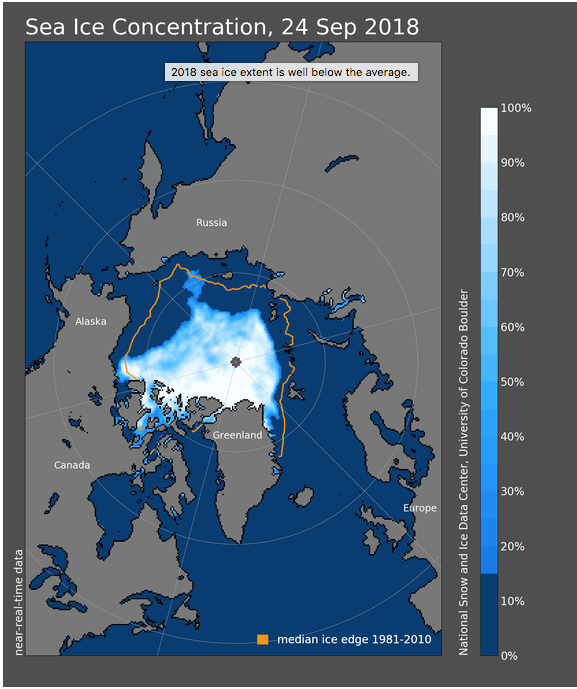
Screen Shot 2018-09-27 at 9.20.05 AMNot good. Not good.  From the article:  for arctic sea ice, “each of the last 12 years have been the lowest 12 years on the satellite record. Some of the thickest, oldest Arctic ice, which is anchored in a compacted mass off the frigid north Greenland shore, broke apart this year. ‘That was oldest, most stable ice in the Arctic,” said Jeremy Mathis, a National Oceanic and Atmospheric Administration scientist. ‘That’s the ice that we thought would hold on the longest.  Something happened this year that is incredibly indicative of just how fast the Arctic is changing,’ said Mathis. ‘That could accelerate the timeline for what could be an ice-free Arctic Ocean during the summer months’.”

Sustainable concrete wont save us #2

By Steve Austin

Another article, of which I expect to see a lot more of, in which the emissions truth of concrete – we can no longer use the stuff in a below zero carbon world – is attempted to be balanced by expressions of our absolute need for that very same stuff.

First the setup:  “If the cement industry were a country, it would be the third largest emitter in the world.”

Then the need:  “Cement use is set to rise as global urbanization and economic development increases demand for new buildings and infrastructure” 

Then the bargaining (with data from the Cement Industry):  “Three of these are the strategies previously being pursued by the cement industry to limit emissions, namely, improved energy efficiency, lower-emission fuels and lower clinker ratios.”  A fourth strategy is “novel” concrete, playing around with technology.  The article doesn’t cover it in much detail, as it offers little chance of scaling.

Finally, the truth- as even the Industry admits: “The roadmap also sets out a “beyond 2C” scenario (B2DS; purple dotted line above), whereby a far higher 60% reduction in emissions would be required. Here, the proportion of total cement CO2 emissions captured by CCS would need to more than double compared to the 2C scenario, up to 63% in 2050, the roadmap says. It notes this ‘will be challenging to achieve’.”

Bottom line:  we think we can’t live without concrete, but we can’t live with it either.  Quite the conundrum.  The solution is for designers to reimagine everything related to design and construction without concrete.

America: the Farewell Tour

Chris Hedges is one of the few telling us like it is. This interview lays out his analysis of just where the American Empire stands.   It is not pretty.  But hearing truth is vital if we are to have realistic hope.

Here’s his final take:   “One of the great existential crises of our time is to understand how bleak the world is, and resist anyway. But pretending that it’s not bleak feeds the mania for unreal hope that exists within American culture that I don’t share. That’s our exit door—it allows us to find excuses not to react with the militancy that we must embrace if we’re going to ultimately survive. There is a moral dimension to fighting radical evil. Most rebels throughout history do not succeed. But you don’t succeed without them, and the situation truly is hopeless if we do nothing. If we resist we have hope, however marginal and impossible that hope may seem. If we don’t resist, you can’t use the word hope.”