‘This report will change your life’: what zero emissions means for UK
from The Guardian
(SA: This is a start….but this report goes off the rails when it still envisions an increase in aviation by 2050….)
“Make no mistake, this report will change your life,” says Prof David Reay at the University of Edinburgh. “If the meticulous and robust expert advice here is heeded it will deliver a revolution in every facet of our lives, from how we power our homes and travel to work to the food we buy.”
The government’s official advisers the Committee on Climate Change (CCC) said on Thursday that the UK’s net greenhouse gas emissions should fall to zero by 2050, emphasising that the transformation is necessary, affordable and desirable.
Setting the legally binding target, which has wide political support, will be the easy bit. But the scale of transformation needed to meet the target is enormous.
By 2050, petrol and diesel cars should be a distant memory, ideally banned from sale in favour of electric vehicles two decades earlier. “2030 would be my ideal switchover date, but we have said 2035 at the latest to be cautious,” said Chris Stark, the chief executive of the CCC. The current date is 2040, but switching sooner will save people money, he said, as electric cars are cheaperin the long run.
The cars will need a lot of electricity, meaning clean power generation must quadruple by 2050, the CCC said. That certainly means more offshore windfarms, but the cheapest option – onshore windfarms – are effectively banned in England. Big storage will also be needed, but battery costs are plummeting.
Homes heated by natural gas will also be long gone, with the CCC saying no new home should be connected to the gas grid after 2025. Electrified heating will be more common, but hydrogen could be an alternative to natural gas, if it can be produced cleanly at scale.
Meat has a heavy environmental impact, but the CCC envisages only a 20% cut in beef, lamb and dairy consumption in 2050, far lower than in other studies and the 86% cut needed to meet UK health guidelines. “We absolutely don’t think there would be support for that [huge cut], or that it is necessary,” said Stark. “A 20% cut seems cautious and prudent to us, but it is true that if you were to shift more to plant-based diets, the [net-zero] target would be easier overall.”
The UK landscape will also significantly change by 2050, if emissions are stopped. A fifth of all farmland – 15% of land – will have been converted to tree planting and growing biofuel crops.
This is essential because some activities, like cattle rearing and aviation, will still emit greenhouses gases in 2050. The CCC target is for “net zero”, with these residual emissions cancelled out by taking carbon out of the air.
New trees are the simplest solution but tree planting must triple from today’s rate, the CCC said, meaning more than 107 hectares (267 acres) a day of new forests from now until 2050. That would be 1.5bn trees, according to Beccy Speight, the chief executive of the Woodland Trust, who said new woods would also help reverse huge losses of wildlife in the UK: “There is a potential win-win here.” Guy Smith, at the National Farmers Union, said it was working towards net zero greenhouse gas emissions from agriculture by 2040.
Flying is included in the net zero target of the CCC, which said there could be a limited expansion of aviation if airlines can cut their emissions per flight, potentially with electric planes for short-haul flights. A few nuclear power stations may still be running, if they can compete on cost, though they are not necessary to meet the target, the CCC said.
read more here
SEE ALSO: The Guardian’s editorial supporting this:
‘Do it now’: UK must set zero-carbon target for 2050, say official advisers
Biodiversity crisis is about to put humanity at risk, UN scientists to warn
from The Guardian
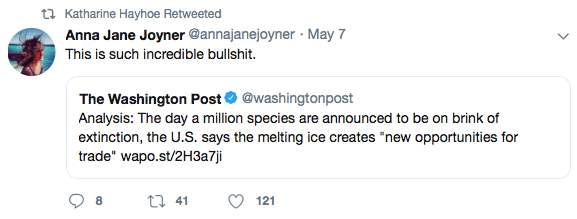
The world’s leading scientists will warn the planet’s life-support systems are approaching a danger zone for humanity when they release the results of the most comprehensive study of life on Earth ever undertaken.
Up to 1m species are at risk of annihilation, many within decades, according to a leaked draft of the global assessment report, which has been compiled over three years by the UN’s leading research body on nature.
The 1,800-page study will show people living today, as well as wildlife and future generations, are at risk unless urgent action is taken to reverse the loss of plants, insects and other creatures on which humanity depends for food, pollination, clean water and a stable climate.
read more here
Build that roof! Build that roof!

SA: Cause what good is a wall on this planet without a roof too?
Or to put it another way, imagine the inhabitants of the spaceship below holding those kinds of signs. The fact that all humans share exactly the same thing – a single spaceship – makes that thought kind of completely ridiculous.
Greenland’s Ice Sheet Was Growing. Now It’s in a Terrifying Decline

Greenland’s ice sheet is melting six times faster than it was in the 1980s. And all that meltwater is directly raising sea levels.
That’s all according to a new study, published April 22 in the journal Proceedings of the National Academy of Sciences, that carefully reconstructs the behavior of the ice sheet in the decades before modern measurement tools became available. Scientists already knew that there was a lot more ice on Greenland in the 1970s and 1980s. And they’ve had precise measurements of the increase in melting since the 1990s. Now they know just how dramatically things have changed in the last 46 years.
“When you look at several decades, it is best to sit back in your chair before looking at the results, because it is a bit scary to see how fast it is changing,” University of California, Irvine, glaciologist Eric Rignot, a co-author of the study, said in a statement.
Greenland is just one island. But its ice sheet has the potential to transform the entire planet. The Greenland ice sheet has existed for 2.4 million years and is 2.1 miles (3.4 kilometers) thick at its deepest point. The whole thing weighs about half as much as Earth’s whole atmosphere, or 6 quintillion — or 6 with 18 zeros after it — lbs. (2.7 quintillion kilograms). If it melted entirely, sea levels would rise by 24.3 feet (7.4 meters).
Between 2000 and 2010, Greenland lost about 412 trillion lbs. (187 trillion kg) of ice per year. Between 2010 and 2018, the ice sheet lost roughly 631 trillion lbs. (286 trillion kilograms) of ice per year.
—-
Those numbers make concrete what researchers and inhabitants of Greenland already knew: that the island is changing and its ancient glaciers are receding at an alarming rate. The dramatic uptick in ice loss in the last two decades coincides with a similar surge in atmospheric greenhouse gases and warming. As Live Science reported earlier this year, nine of the 10 warmest winters on record have happened since 2005.
What does this all mean for the future of the ice sheet, as well as global sea levels? As the Intergovernmental Panel on Climate Change concluded, that will depend primarily on what humans do next.
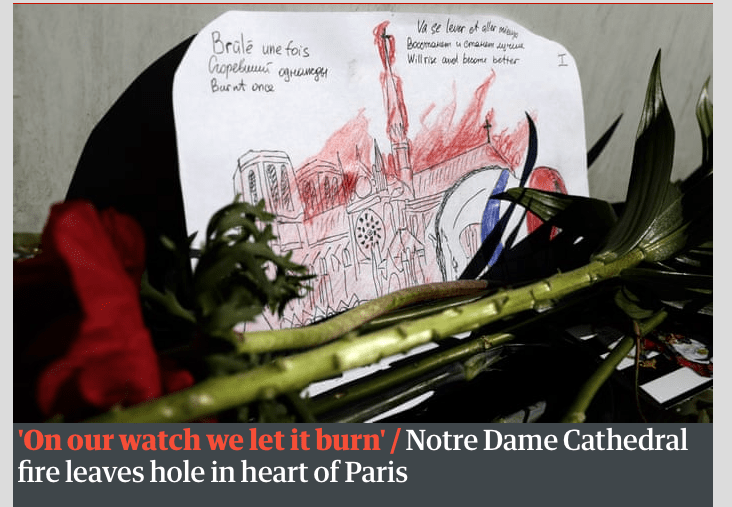
“On our watch, we let it burn”
By Steve Austin
Sadly, the headline does not refer to a livable climate. But the consequences are far worse. From The Guardian.
Negative Emissions Won’t Rescue Us From Climate Change
By Andy Stone in Forbes
“,..despite the major political barriers to dramatic near-term emissions cuts, a terrifying realization is that such action is, in fact, the most realistic option available to hold climate change in check. Of the climate action pathways modeled by the IPCC, the scenario that requires boldest action in the near term is the only one that doesn’t also require a leap of faith that a suite of uneconomic, logistically challenging, and ultimately unproven negative emissions technologies will in fact deliver us from our collective peril.
The gulf between the promise of these technologies (a multitude of variations on carbon capture and storage) and their real ability to offset a future of high carbon emissions appears unbridgeable, if not in terms technological viability, then almost surely in terms of magnitude and scale.
—–
….none of this is to say negative emissions aren’t possible or a worthwhile pursuit. It’s just that they’re only going to be a partial solution to the climate problem, akin to an insurance policy whose payout is likely to prove woefully inadequate when disaster strikes. We place our bets on the promise of negative emissions, and the dangerous political complacency that such faith engenders, at our global peril.”
The entire piece has a very detailed examination of the physical realities of negative emissions- read it all here
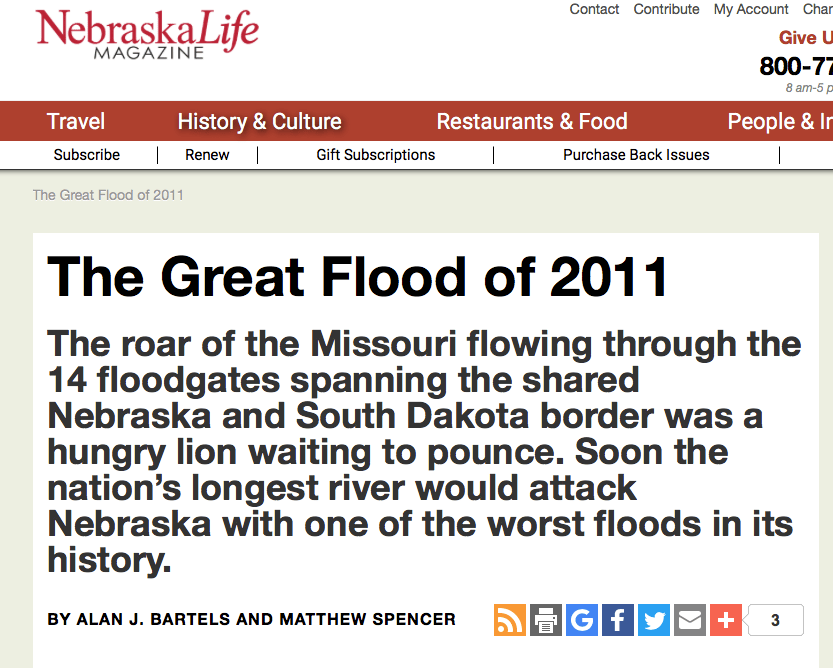
“Generational Flooding”: Now happening every few years
By Steve Austin
Can it just be a streak of bad luck? Unfortunately, for the poor souls who are suffering through this, it might just be the new normal thanks to climate change.
Now in 2019….

Uh oh: Global CO2 emissions hit record high in 2018
(remember: CO2 emissions don’t need to just decline. They need to go to zero….and yet here we are….)
LONDON, March 26 (Reuters) – Global energy-related carbon emissions rose to a record high last year as energy demand and coal use increased, mainly in Asia, the International Energy Agency (IEA) said on Tuesday.
Energy-related CO2 emissions rose by 1.7 percent to 33.1 billion tonnes from the previous year, the highest rate of growth since 2013, with the power sector accounting for almost two-thirds of this growth, according to IEA estimates.
The United States’ CO2 emissions grew by 3.1 percent in 2018, reversing a decline a year earlier, while China’s emissions rose by 2.5 percent and India’s by 4.5 percent.
Europe’s emissions fell by 1.3 percent and Japan’s fell for the fifth year running. Continue reading “Uh oh: Global CO2 emissions hit record high in 2018”
The deadly truth about a world built for men – from stab vests to car crashes
Not climate related, but vital for us as designers and planners to understand.
From The Guardian:
Crash-test dummies based on the ‘average’ male are just one example of design that forgets about women – and puts lives at risk
Going back to the theory of Man the Hunter, the lives of men have been taken to represent those of humans overall. When it comes to the other half of humanity, there is often nothing but silence. And these silences are everywhere. Films, news, literature, science, city planning, economics, the stories we tell ourselves about our past, present and future, are all marked – disfigured – by a female-shaped “absent presence”.
Read more here
 steve austin