Sustainable concrete wont save us #2

Headline from Treehugger.com:  Cement industry gets on board with Paris Climate Accord

Key takeaway from the article:  “Exactly how they will do this remains to be seen…” AND “…the launch of the effort did stipulate that as much as 50% of the technology needed to meet this daunting challenge has yet to be fully developed…” (emphasis mine)

In other words, the industry is slopping some greenwash on what is in reality a desperate situation for themselves.  Cement emissions must fall to essentially zero (as opposed to the near 10% of global emissions they are now). As cement production is highly CO2 intensive, the inescapable conclusion must be that concrete use must basically cease.  Nor is there is an honest possibility of off-setting cement emissions by planting trees.  The billions of trees that need to be planted will need to function to draw down existing emissions, not to offset continued emissions.

The world has yet to understand that all human caused CO2 emissions must be as near zero as possible, and that all our efforts must be directed toward removing the excess CO2 already in the atmosphere.  We dont get to keep cheating by offsetting continued emissions. Cement production is cheating.

Yet, how can the entire global civilization function without concrete?  What do we do for all new building projects, let alone how do we repair all the existing concrete structures, the vast majority of which have less than 100 year lifespans? THOSE are the key questions that bright minds must be focusing on, instead of trying to prop up an industry that is part of the problem.
 

15-20 sea level rise within 70 years not out of the question

By Jeff Goodall, Rolling Stone.

Another frightening mainstream media story about the impacts of climate change on sea level rise.  Key takeaway:  “As bad as you think climate change might be in the coming decades, reality could be far worse…..[Dr. Richard]Alley says, there’s some risk — small but not as small as you might hope — that the seas could rise as much as 15-to-20 feet.”

Read the rest here.

UN Says Climate Genocide Is Coming. It’s Actually Worse Than That.

This is an excellent, although frightening, summary on what the October 2018 UN climate report means for the world. Key takeaway:  “The New York Times declared that the report showed a “strong risk” of climate crisis in the coming decades; in Grist, Eric Holthaus wrote that “civilization is at stake.”

If you are alarmed by those sentences, you should be — they are horrifying. But it is, actually, worse than that — considerably worse. That is because the new report’s worst-case scenario is, actually, a best case. In fact, it is a beyond-best-case scenario. What has been called a genocidal level of warming is already our inevitable future. The question is how much worse than that it will get.”

By David Wallace-Wells in New York Magazine. (go to the source for links in the original article)

Just two years ago, amid global fanfare, the Paris climate accords were signed — initiating what seemed, for a brief moment, like the beginning of a planet-saving movement. But almost immediately, the international goal it established of limiting global warming to two degrees Celsius began to seem, to many of the world’s most vulnerable, dramatically inadequate; the Marshall Islands’ representative gave it a blunter name, calling two degrees of warming “genocide.”

The alarming new report you may have read about this week from the UN’s Intergovernmental Panel on Climate Change — which examines just how much better 1.5 degrees of warming would be than 2 — echoes the charge. “Amplifies” may be the better Continue reading “UN Says Climate Genocide Is Coming. It’s Actually Worse Than That.”

Technology won’t be the answer to climate change

This is an excerpt of a longer article from Motherboard about the October 2018 UN climate report.  Well worth a read.  Key takeaway:  “…relying on largely imaginary technologies to help us stave off the threat of extinction is astonishingly stupid.”

By Nafeez Ahmed

But other studies imply there is one glaring weakness in the IPCC report: its unbridled enthusiasm for geoengineering techniques to drawdown carbon from the atmosphere.

These play a major role in the report’s transition scenario pathways, and include ‘negative emissions’ technologies designed to drawdown carbon emissions from the atmosphere. The main technology being proposed is called ‘BECCS,’ which stands for ‘bioenergy with carbon capture and storage’. This basically proposes burning biomass for energy, and capturing the carbon emissions to be stored underground.

While the technology has been tested and proven at small-scales, commercial scale operations have yet to be built—and the key obstacle appears to be the massive costs associated with the technology.

A recent paper in the Royal Society of Chemistry’s Environment, Energy and Science journal examines BECCS from a ‘net energy’ standpoint to measure how much energy it would require, compared to what it produces. The paper found that under current technologies, “more energy is used to operate BECCS than what is returned to society”, a serious problem which could result in greater use of fossil fuels to keep BECCS alive, and “an increase in CO2 emissions, with a potential offset of the carbon dioxide removal service provided by BECCS.”

The study identifies ways BECCS might be made more efficient, cheaper, and less energy intensive, but admits that the practical feasibility of those mechanisms is unclear and “the scope for unintended consequences is vast.”

The last word on the subject came in last month via a comprehensive study published in Nature Communications, evaluating a whole gamut of negative emissions technologies. While acknowledging that “several techniques may eventually have the physical potential to contribute to limiting climate change,” the study concludes that “all are in early stages of development, involve substantial uncertainties and risks, and raise ethical and governance dilemmas.”

Reviewing a range of ‘climate dioxide removal’ and’ radiative forcing geoengineering’ Continue reading “Technology won’t be the answer to climate change”

The Hope at the Heart of the Apocalyptic Climate Change Report

BY JASON HICKEL Foreign Policy.com

When the Intergovernmental Panel on Climate Change (IPCC) published a new special report last week, it came with both good news and bad. The good news is that the carbon budget for staying under 1.5 degrees Celsius of warming is larger than we thought, so we have a bit more time to act. The bad news is that the consequences of overshooting that threshold are very, very bad. The catastrophes that we once believed would be triggered by only 2 degrees of warming are likely to occur at this lower threshold, including widespread collapse of food yields and extreme levels of human displacement.

The IPCC has issued a clear and trenchant call for action—its most urgent yet. It says we need to cut annual global emissions by half in the next 12 years and hit net zero by the middle of the century. It would be difficult to overstate how dramatic this trajectory is. It requires nothing less than a total and rapid reversal of our present direction as a civilization.

The challenge is staggering in its scale, and the stakes are even more so. As the co-chair of an IPCC working group put it, “The next few years are probably the most important in our history.” After decades of delay, this is our last chance to get it right. Most people hope that we’ll be able to prevent catastrophe by rolling out clean energy systems, ultimately decarbonizing the economy.

But so far this plan has not been working very well. Global emissions continue to rise, Continue reading “The Hope at the Heart of the Apocalyptic Climate Change Report”

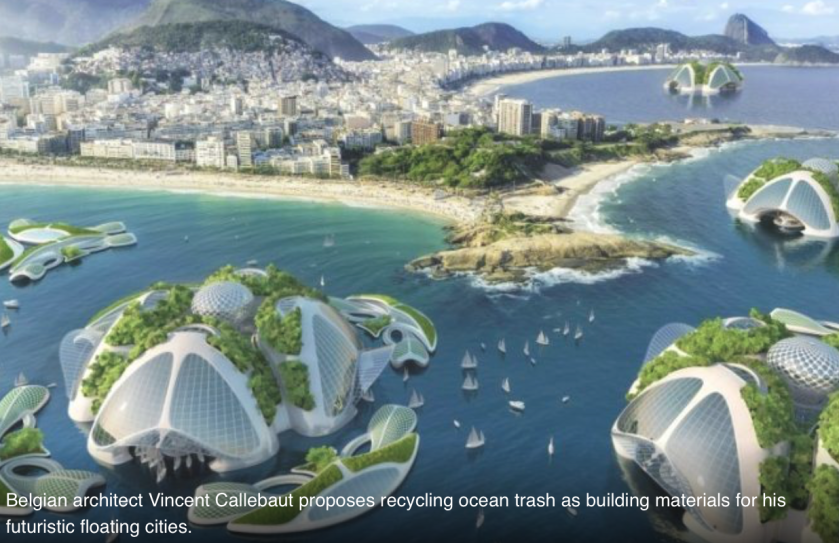
The solution for climate refugees? Floating cities. Really.

Screen Shot 2018-10-19 at 10.43.08 AM

An article was recently posted on archdaily.com that discusses perhaps the most serious impact of climate change:  human migration as people flee rising coastlines, storm inundated areas, and drought.  A proposed solution?  Floating cities.  Yes, here is the greatest threat that humanity has ever faced, and some architects and city planners believe that mega structures are the appropriate response.

While I appreciate the creativity, these ideas show an utter lack of the realities we face.  We must cease industrial levels of energy and material use within no more than 30 years. Grand visions must be replaced by small scale, local, and bioregionally based adaptations.

There wont be any great images that will come from that, but it is what is needed, and in fact, what will happen, eventually, in the wake of great destruction and upheaval if nothing else.

Screen Shot 2018-10-19 at 10.46.48 AM

All designers must begin to challenge these kinds of ideas:  Where will the energy come from to build such things?  The materials?  How will it be maintained in the low energy future?  What resources would be used for this and how could they be better used?

There will be no starchitects in the coming world.  Only people whose innate creativity will help us work with reality.

ASLA Statement on IPCC Climate Change Report

I’m a proud member of the American Society of Landscape Architects (ASLA). However, their recent statement regarding the recent UN climate report leaves a lot to be desired:

“Already, the dire effects of climate change are visible in every corner of the globe. But the startling new report of the U.N. Intergovernmental Panel on Climate Change makes clear that if significant actions aren’t taken immediately, the world could see a rise in atmospheric temperatures of 1.5 degrees Celsius by 2040, triggering catastrophic effects worldwide. Landscape architects work at the intersection of the built and natural environments and have embraced their responsibility to design and plan healthy, climate-smart and resilient communities. The ominous U.N. report further reinforces the need for all those responsible for shaping human environments to urgently redouble their efforts to both mitigate climate effects and to ensure the resilience of communities already being threatened by the consequences of inaction.”

The ASLA statement acknowledges that the UN report is “startling” and “ominous.”

Despite that, the ASLA appears to have not been startled enough to change their typical messaging in any way.  Instead, they repeat the same trope that they have for years:  “Landscape architects work at the intersection of the built and natural environments and have embraced their responsibility to design and plan healthy, climate-smart and resilient communities.”

Sounds great.  Unfortunately, the UN report makes clear is that we have less than 30 years to eliminate fossil fuels from our work and society as a whole. Thus that stock statement needs to be revised to say what landscape architecture is doing to prepare not only our profession but also our communities for that as well.  We should be talking about leading by example into the zero carbon future.

Positively, the ASLA statement mentions the need for “all those responsible for shaping human environments to urgently redouble their efforts to …mitigate climate effects.” However, “all those responsible” are us as landscape architects.  What are WE going to do to mitigate climate change?  If we are to be part of the solution moving forward, we have to be leaders through the complete decarbonization of our work.  At this stage, as shown clearly by the report, mitigating climate change is now an all or nothing proposition if we are to avoid the worst possible future.

Certainly, there is no quibble with the last line of the statement that we all need to “ensure the resilience of communities already being threatened by the consequences of inaction.”

I sincerely hope that landscape architects, especially young ones, will push to make ASLA a world leading organization as we enter this new era.


The Climate Report That Changes Everything for Landscape Architecture

By Steve Austin

Originally published at Land8 Landscape Architects Network

On October 8, 2018, the UN released a bombshell report whose implications will shake the profession of landscape architecture to its core. The report lays out clear evidence that if world governments don’t take drastic action to end the fossil fuel era over the next decade, in the very near future humanity will witness severe food shortages, climate related poverty increases, and massive ecological destruction, all leading to unprecedented human migration.

This is ultimate proof of the destructiveness of fossil fuels and the first time we’ve definitively been presented their needed expiration date.

“This report shows that we only have the slimmest of opportunities remaining to avoid unthinkable damage to the climate system that supports life as we know it,” said Amjad Abdulla, an International Panel on Climate Change (IPCC) board member, in a release. Debra Roberts, co-chair of one of the IPCC working groups, is quoted as saying of our situation: “The next few years are probably the most important in our history.”

In order to maintain that slim opportunity, the report argues that the nations of the planet must soon stop burning fossil fuels to keep global temperature from increasing no more than 1.5 Celsius (C) above pre-industrial levels.

If landscape architecture is to be a vital part of the future, this report means that our work, which is now utterly dependent on fossil fuels, must change completely during a time when it will be needed more than ever.

Where things stand now

The planet has already warmed by 1C (approximately 1.8 degrees Fahrenheit) and Continue reading “The Climate Report That Changes Everything for Landscape Architecture”